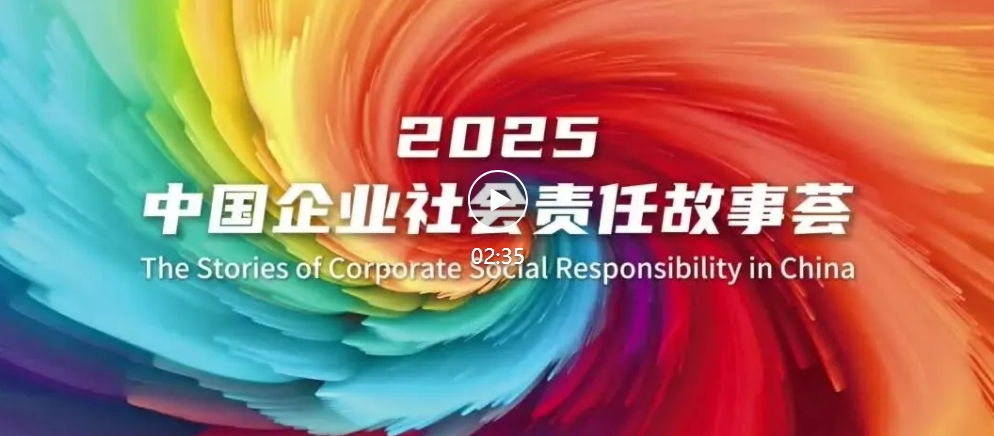
The legacy of human civilization has always been carried forward through stories. Within the grand narrative of corporate sustainable development, vivid and dynamic stories serve as agile threads that tightly connect corporate practices with societal development needs, transforming abstract concepts into something tangible, communicable, and enduring.
In today's increasingly competitive market landscape, where core brand competitiveness has expanded beyond products and technologies to encompass cultural value and spiritual inspiration, telling compelling corporate sustainability stories has become a crucial channel for business to convey responsibility and a key strategy for building long-term competitive advantage.
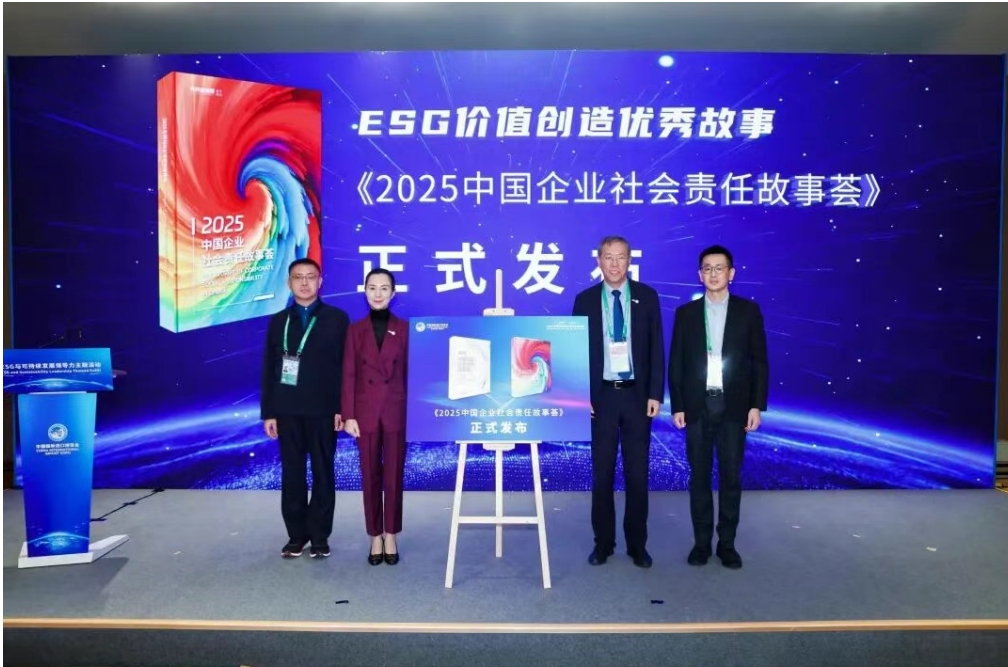
On November 7, 2025, at the side event "Capitalize on Trends, Drive Sustainable Value – ESG and Sustainability Leadership Themed Event" during the 8th China International Import Expo(CIIE), the 2025 Stories of Corporate Social Responsibility in China was officially launched. The release ceremony was witnessed by distinguished guests including Yu Zhihong, President of China Sustainability Tribune, Tian Xiaohong, Deputy Secretary-General of Shanghai Service Industries Development & Research Foundation, Li Chengxi, Director of the Social Responsibility Department at State Grid Jiangsu Electric Power Company's Convergence Media Center, and Li Chengzhi, Senior Researcher at Ansteel Economic Development Research Institute.
The Stories of Corporate Social Responsibility in China series remains steadfast in its original mission of discovering authentic practices and amplifying positive voices. By refining CSR stories with a human touch, profound insight, and broad relevance, it builds a bridge for dialogue between Chinese enterprises and the world, allowing China's credible, appealing, and admirable image to naturally emerge through narrative.
The newly released Chinese-English bilingual 2025 edition focuses on core topics of social responsibility and sustainable development, spanning diverse areas including energy transition, rural vitalization, responsible production, health and well-being, circular economy, sustainable lifestyles, and natural disaster prevention. Through concrete practical scenarios and vivid cases, it deeply deconstructs leading enterprises' innovative explorations in sustainable development, making each CSR commitment resonate deeply with readers.
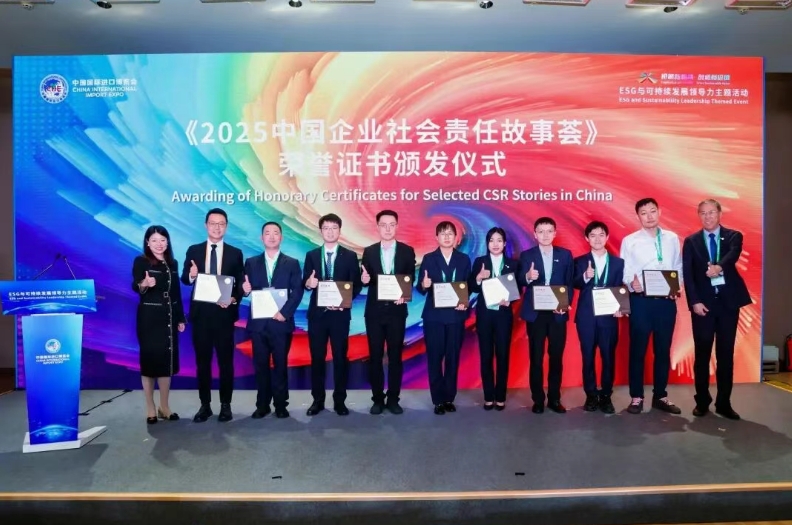
Story summary
As both “Pioneer of Photovoltaic Power in China” and the “Capital of New Energy Vehicles”, Hefei faces a dual challenge in its energy transition: the intermittency of new energy leads to fluctuations in grid load, while the massive charging demand from NEVs easily leads to “peaks upon peaks”. How can scattered green energy sources be aggregated to achieve a precise balance between supply and demand? State Grid Hefei has built China’s first “5G + quantum encryption” virtual power plant, integrating resources such as PV generation, energy storage, and charging facilities to dispatch electricity with second-level precision. Taking these factors into consideration, can this invisible energy network ensure the stable supply of green power to the city?
Once scarred by floods and bound by coal, Zaozhuang, the “Bright Pearl of South Shandong”, stood at the crossroads of transformation. When Zhou Enlai, then Premier of China, approved a power-driven irrigation and drainage station in 1963, waterlogged fields blossomed into golden paddies. Today, the 1,000kV ultra-highvoltage station tells a new story of green energy. indmills and PV panels crown the Mishanding, while smart grids guard the city’s pomegranate orchards. As storage and virtual power plants open new paths for green power, can Zaozhuang safeguard its natural beauty and reap the benefits of shared prosperity over the decades of energy transformation?
If time could paint the earth, the first century of Ansteel’s Dagushan Iron Mine would be rendered in a deep, weighty industrial gray. That gray once defined the foundation of China’s steel industry: a color of strength and sacrifice, bearing the nation’s mission to forge steel for its prosperity, and leaving indelible industrial imprints upon the land. Yet over the past two decades, a new hue, ecological green, has begun to permeate this weathered canvas with unstoppable vigor. Through systematic ecological restoration, Ansteel Mining has transformed 79 hectares of abandoned waste rock dumps and tailings ponds into forests and flower fields. Once a dusty “mining desert” was turned into a vibrant demonstration of the principle that lucid waters and lush mountains are invaluable assets. It offers a replicable “Ansteel’s Solution” to the green transformation of mining areas for China and even the world.
The Jiangning Development Zone, occupying just 5% of Nanjing’s land yet generating 11% of its GDP, is home to four hundred-billion-yuan industrial clusters, with an urgent demand for green energy. However, fragmented microgrids and siloed carbon data hamstrung the region’s green transformation. In response, State Grid Jiangning spearheaded the creation of a Green Energy “Synergy Ring,” using an interconnected smart microgrid and an “Energy Carbon Brain” to realize unified control and seamlessly coordinate solar and storage resources. Can this industrial park’s energy revolution become a blueprint for green industrial upgrades nationwide?
“An entire set of auto parts can be sourced in Luqiao District within just one hour.” Luqiao District of Taizhou City is home to more than 1,000 manufacturers in the automotive industry chain, producing new energy vehicles that are exported across China and to global markets. Yet, these companies face a pressing dilemma i.e. booming orders require round-the-clock production, but soaring electricity costs and high equipment energy consumption threaten their competitiveness, especially as their products confront international green trade barriers. How can they strike a balance between expanding production and reducing carbon emissions? State Grid Luqiao is using green and intelligent technologies as an engine to inject strong momentum into energy conservation and carbon reduction across the automotive industry chain. Will this targeted empowerment enable the “City of Automobiles” to take the lead on the green development track?
For children suffering from methylmalonic acidemia (MMA), special medical formula is their essential lifeline. Yet, 80.5% of affected families in China have faced supply shortages. Lengthy delays in cross-border purchasing, soaring prices, and the complexity of dietary management have left families living under constant anxiety. When the market failed to ensure a stable supply of this essential product, Alibaba Health stepped beyond traditional charity models and pioneered a new path that integrates philanthropic aspiration with business innovation. Through a “supply-bydemand” model, Alibaba Health has built a reliable supply chain and developed a smart diet calculator to help families better manage daily nutritional requirements. Can this innovation finally free every “lemon baby” from the fear of losing their vital lifeline?
Turning off the air conditioner for one hour less reduces carbon emissions by 621 grams, and cycling one kilometer cuts carbon emissions by 270 grams. How can these tiny individual low-carbon actions converge into a collective force for carbon reduction? As a province with relatively high residential carbon emissions, Jiangsu is confronted with the challenge of guiding all the citizens to engage in carbon reduction. State Grid Wuxi has built the “Carbon Fashion” platform to quantify behaviors such as public transport travel, waste sorting, and waste recycling into carbon points that can be redeemed for travel coupons, cultural and creative products, and even low-interest loans. Can this public-engaged “carbon game” turn green living into a trend?
A rural market bustles with the energy of early morning, but a tangle of illegal wiring, old batteries sitting next to gas cylinders, and overloaded power strips have turned the lively U-shaped street into a ticking time bomb. Governance was deadlocked: the village committee had no power to enforce rules, the power company could spot risks but not mandate changes, and fragmented efforts from different departments failed to create synergy. State Grid Tiantai led a “Village-Grid Collaboration” initiative, solving the power dilemma with “fixed sockets + mobile power banks” and using a three-color management system to regulate vendors. Can this energy innovation make the market’s vibrant atmosphere truly safe?
The scenic waterways of Xinyi city, Xuzhou, are beautiful, but they hide a deadly risk. Statistics show that an average of 88 children drown every day in China, with riverbanks becoming high-risk zones in the summer. Could the thousands of power transmission towers lining the water do more than just supply power? State Grid Xuzhou activates the towers as “Sky Eyes” for surveillance, forming an anti-drowning alliance with the government, police, and rescue teams to build a “Air Ground-Human” integrated prevention system. From remote drone warnings to onsite patrols, can this cross-sector safety net safeguard the precious childhood of every child?
In recent years, global warming has significantly increased the frequency and intensity of hydrometeorological events. Typhoons, torrential rains, and floods have become a “Sword of Damocles” hanging over Zhejiang Province. Taizhou City is known as a “city of mountains, seas, and rivers,” and especially its Huangyan District, with distinctive geographic features, has become the frontline of flood and typhoon prevention efforts in Taizhou and coastal areas of Zhejiang. In response to flood disasters, State Grid Huangyan, in collaboration with its technological team, developed an AI-powered flood prevention radar system and waterproof power equipment, transforming underground distribution rooms from passive defense to proactive early warning, and building a robust safety shield for the city’s power infrastructure.
Enduring success is achieved not through solitary excellence, but through collective efforts and shared prosperity. We believe these stories will inspire more companies to embrace their CSR to advance their own development while contributing Chinese wisdom and solutions to global challenges. We also hope these stories transcend borders and cultures, enabling the world to better understand the commitment of Chinese companies and appreciate China’s dedication to sustainable development. Through these efforts, we can gather powerful and collaborative momentum worldwide to jointly create a brighter future where humanity and nature coexist in harmony.

About the Stories of Corporate Social Responsibility in China
During the 5th China International Import Expo (CIIE), China Sustainability Tribune joined forces with the China Enterprise Confederation and other organizations to launch the Stories of Corporate Social Responsibility in China initiative. This initiative aims to identify distinctive, impactful, and effective corporate practices from the rich landscape of CSR activities in China. By curating and refining compelling, emotionally resonant, and influential CSR stories, the initiative seeks to "tell China's stories well and communicate China's voice effectively.
The Stories of Corporate Social Responsibility in China selects representative, innovative, and inspiring CSR cases based on their exemplary nature. Each story is meticulously crafted across six dimensions—factual accuracy, emotional authenticity, brand alignment, integrated messaging, narrative rhythm, and value demonstration—to refine the narrative perspective, content, and presentation. This approach vividly conveys companies' sense of responsibility, the value of their solutions, and the essence of practices, along with the tangible impacts and changes achieved. The stories aim to resonate emotionally with readers, offering both inspiration and practical insights.
For more information, please contact:
 Back
to top
Back
to top