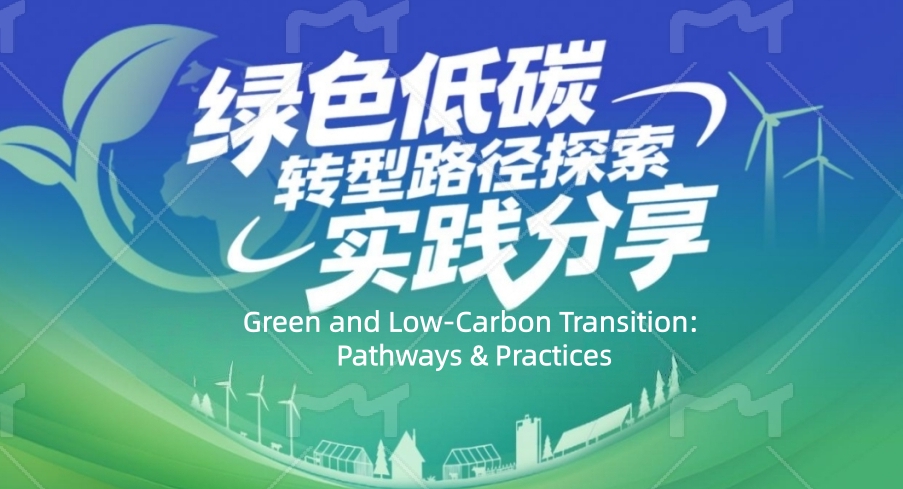
Green and low-carbon transition is now essential for high-quality economic development. As key drivers in urban decarbonization, industrial parks and enterprises are advancing energy mix optimization, industrial upgrading, and pollution reduction.
On November 28, 2025, the "Green and Low-Carbon Transition: Pathways & Practices" Workshop was successfully held in Beijing. The event, focusing on transition practices of industrial parks and enterprises, brought together experts, institutions, and leading companies to share case studies and promote green technology application. The discussions aimed to foster a new model of "park-led, enterprise-supported, city-coordinated" low-carbon transition.
During the workshop, several representatives shared their insights from their perspectives.Industrial Solutions: Qi Yue, Director of the Climate Program at Children's Investment Fund Foundation, proposed to synergize innovation and structural optimization in key industries, leverage the opportunity of zero-carbon park development to explore multi-tiered emission reduction,address fiscal, tax, and financial barriers to high-carbon industry transition and strengthen multi-stakeholder collaboration to promote low-carbon principles through green supply chains, jointly advancing global green development.
Policy Context: Huang Jing, member of the National Climate Change Expert Committee outlined China's 2035 NDC targets and pathways, emphasizing translating national goals into local, sectoral, and corporate actions.
Platform Insights: Yu Zhihong, President of China Sustainability Tribune and founder of the "GoldenKey 鈥?SDG Solutions", shared observations on corporate decarbonization. He noted the platform's collection of over 1,000 outstanding cases since 2020, revealing China's shift from strategic vision to systemic implementation between 2015 and 2025.
Park-Level Practices: Zaozhuang focused on zero-carbon industrial park development within resource-based city transitions. Key successful experiences included: strategic guidance, institutional innovation, industrial foundation, energy revolution, and technological enablement. The success of Zaozhuang's "Zero-Carbon Intelligence Valley" provides valuable lessons for the transformation of resource-based cities.
Corporate Solutions: CECEP Consulting detailed pathways to enhance corporate carbon management for competitive advantage. Guangdong Southern CCS Center, outlined the roadmap for zero-carbon industrial parks using Zaozhuang as a case study. Shenzhen Huagong Energy presented its innovative "Direct Green Power" solution. The Zhongguancun Industrial Internet Park shared its green transition journey. The Green Partnership of Industrial Parks emphasized planning-led transformation via "3-Green Pathways" and "3E Goals."
Grid Innovations: State Grid Changzhou introduced the Liyang Near-Zero Carbon Park, a major provincial model boosting the local economy. State Grid Xuzhou Tongshan presented a "franchise" model for microgrids in small-to-medium industrial parks, demonstrating replicable, cost-effective solutions.
The workshop,hosted by the Green Development Institute of Beijing Normal University and co-organized by the China Sustainability Tribune, provided a platform for exchanging actionable strategies to accelerate the green transition across China's industrial landscape.
 Back
to top
Back
to top