On a morning in August 2023, fifty new energy vehicles (NEV) with brand new green plates trickled in an EV charging station at No. 3 Changjiang Road, Wuxi City, Jiangsu Province. The drivers connected their vehicles to charging piles marked with a green lightning bolt and the 鈥淪tate Grid鈥?symbol. With a single click on the mobile app, the blue light on the charging piles lit up, discharging electricity from the fifty vehicles into the grid.
Indeed, these vehicles weren鈥檛 there to charge up. Instead, they were delivering power back to the grid. After thirty minutes, the background system that monitors the discharging power and the load curve of the main power source in real time showed that the discharging power of the fifty vehicles reached nearly 2 MW, meaning that the output of half an hour was equivalent to the daily electricity consumption of 133 households.
Next to the charging piles were several vehicle owners with their curious eyes on the fluctuating discharging data on their screens. They were talking about it heatedly. 鈥淲e鈥檝e been merely charging our cars. Never thought we could send power back from the car to the grid!鈥?said one owner, who recorded a short video and shared it in his group chat, sparking a flood of astonishment, curiosity, and excitement.
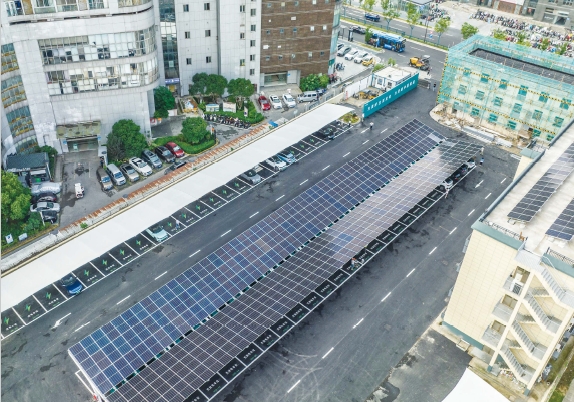
This 15,000 m2 site is home to the largest Vehicle-to-Grid (V2G) charging cluster in China, namely the Wuxi Vehicle-Grid Interaction Verification Center (e-Park) built by State Grid Wuxi Electric Power Supply Company (鈥淪tate Grid Wuxi鈥?for short). The fifty NEV owners participated in the largest practical Vehicle-Grid interaction test in the country. They may not yet fully realize what they had witnessed, which is the concept of turning electric vehicles into 鈥渕obile power banks鈥?that has begun to take root in China.
New Energy Waves Surge as Pioneers Take the Lead in Charging
In the context of international effort to achieve carbon peaking and carbon neutrality, the increasing share of global new energy generation has brought the challenge of handling its 鈥渋ntermittency鈥?and 鈥渋nstability鈥? The NEVs, as battery-loaded runners, can serve as mobile, distributed energy storage facilities, helping enhance grid efficiency, optimize resource allocation, and boost the grid鈥檚 clean energy absorbing capacity. What enables such interaction between EVs and grids is the V2G technology used at Wuxi Vehicle-Grid Interaction Verification Center鈥檚 charging piles.
The V2G technology, also known as Vehicle-to-Grid interaction technology, is one of the key approaches to promoting the development of new electric power systems. Simply speaking, EVs act as mobile storage units that charge during off-peak times and discharge back to the grid during peak times, creating a dynamic and efficient 鈥淣EV + grid鈥?energy ecosystem. This approach achieves a win-win outcome by balancing the grid鈥檚 peaks and troughs for stable operation while enabling EV owners to earn from reverse discharging.
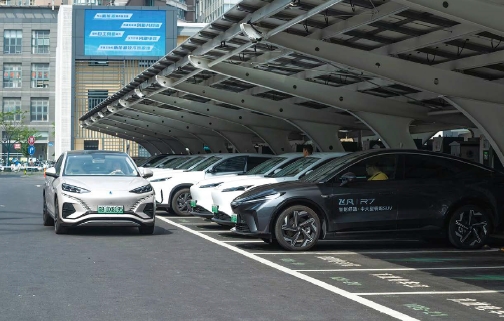
The concept of V2G technology was actually proposed over 20 years ago, with regions and countries like Europe, the United States, and China conducting various pilot projects over the years. In recent years, China鈥檚 NEV market has seen rapid growth. By the end of 2023, there were 20.41 million NEVs nationwide. As expected by experts, by 2040, China鈥檚 NEVs could exceed 300 million, with annual electricity consumption rising by 2.68 trillion kWh, accounting for 17% of the country鈥檚 total electricity consumption. By then, the daily peak charging power could reach 587 GW. This remarkable growth potential provides a strong foundation and confidence for China to advance and implement the V2G technology.
Since early 2022, China has been introducing V2G-related policies. However, while the V2G sounds highly promising, its actual implementation has been slow. Challenges include non-standard regulations, immature vehicle-grid interaction technology systems and application solutions, and the absence of critical technical standards, all of which can lead to grid overload. Additionally, the high costs of its infrastructure, the lack of a clear business model, limited information for electricity pricing and trading rules, and low acceptance among the public have also hindered the progress. As of May 2023, only about 1,000 charging piles nationwide were equipped with V2G functions, accounting for a mere 0.025% of all charging piles.
At this time, it becomes essential for forward-thinking and innovative enterprises to step up, take the lead, and launch pilot projects to develop a mature and feasible application model for implementing the V2G technology in China. Unlike in Europe and the United States, where automakers lead the V2G trend, China鈥檚 V2G demonstration projects are spearheaded by power grid companies. The reason is obvious: China boasts the world鈥檚 largest installed capacity of new energy and is home to the world鈥檚 largest utility company鈥擲tate Grid Corporation of China.With a combination of advantages, State Grid Wuxi is well-positioned to take the lead in pioneering diverse vehicle-grid interaction scenarios, a charging pioneer.
Piloting V2G Applications
As mentioned above, the large-scale application of V2G technology faces unresolved challenges in such areas as technology, policy, and awareness. Only by addressing the fundamental issues in V2G technology pathways and business models, could State Grid Wuxi make breakthroughs in charging pile construction and operation, unlock the potential of NEVs as flexible mobile storage resources, and eventually achieve an integrated development model for NEVs, intelligent networked systems, road infrastructure and cloud computing technologies.
The application of V2G technology spans multiple industries, each managed by different departments, making coordination essential. After the Wuxi Vehicle-Grid Interaction Verification Center Project was launched, the first step taken by the company was to engage stakeholders through field studies, discussions, and exchanges. The step aimed to integrate the resources and interests of various external stakeholders and encourage collective participation. For instance, the government offered land and policies; the research institutions such as State Grid Jiangsu Electric Power Research Institute and Tianjin University provided technical expertise; the NEV manufacturers contributed R&D capabilities and brand influence; the operators brought management experience; and the NEV owners and nearby residents offered insights on needs and preferences. Under the guidance of the State Grid Wuxi, on August 23, 2023 when 50 NEV owners joined the trial, the Wuxi Vehicle-Grid Interaction Verification Center Phase I Project became operational, equipped with 50 sets of 60kW DC charging and discharging units, achieving a maximum discharging capacity of 3 MW.
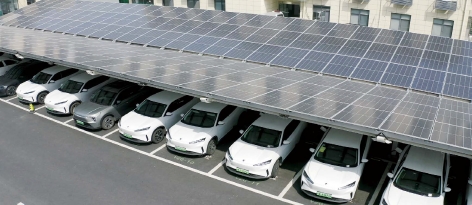
The Wuxi Vehicle-Grid Interaction Verification Center employs intelligent management. To this end, the company has implemented a multi-energy management system that integrates various modules: PV generation monitoring, energy storage monitoring, distribution system monitoring, charging system monitoring, intelligent maintenance for charging facilities, smart streetlight control, energy coordination control, and an orderly charging platform. These modules connect with external systems to ensure efficient charging station operations and energy coordination control. The electricity contributed by vehicle owners is directed to Wuxi鈥檚 virtual power plant platform, and ends up in demand response, ancillary power services, and other market-oriented scenarios, achieving the goals of peaking load shifting and reducing grid fluctuations.
Of course, there are diverse EV charging scenarios and electricity demands in daily life, and success in one single scenario is far from sufficient for large-scale implementation. To enable EVs to charge with green, economical and friendly power, since the Center was launched, State Grid Wuxi has initiated dozens of vehicle-grid interaction application tests at the Xinwu District Bus Company Station in Wuxi, Guangying Group Office Park, and Baita Village Parking Lot. These tests involve nearly a thousand vehicle interactions, covering major application scenarios including urban fast-charging stations, bus charging stations, rural micro-grids, industrial park micro-grids, and residential complexes.
During predicted peak electricity demand periods, the company sends reverse discharging invitations to nearby EV users via the eCharging App and other channels. These scenarios deploy test devices with distinct technical focuses to assess differences in power quality, loss rates, and efficiency for reverse discharging across various car models and ages. They also analyze EV owners鈥?preferences to different charging prices, and also study pricing strategies for reverse discharging and for the coordinated integration of distributed photovoltaic storage. The tests also explore resource integration model within stations to engage in demand-side management and power market models. These experiments have generated extensive firsthand data for State Grid Wuxi鈥檚 ongoing research, providing invaluable empirical evidence for the broader implementation of V2G technology in China and advancing the in-depth research and innovation across multiple related fields.
Meanwhile, the Wuxi Vehicle-Grid Interaction Verification Center Phase II Project is progressing rapidly. Built upon the first phase, which achieved four key functions 鈥?PV generation, energy storage, charging, and reverse discharging 鈥?the second phase will introduce fast battery swapping, liquid-cooled ultra-fast charging, and charging pile inspection facilities, as well as a regional car-hailing operations center and a high-standard driver service center. Once completed, the Center will support nine comprehensive functions: PV generation, charging, storage, discharging, inspection, swapping, R&D, training, and integrated services. It will feature a total of 373kW solar power capacity and 564 kW/1147 kWh energy storage capacity, enabling simultaneous charging for 144 vehicles, reverse discharging for 50 vehicles, and battery swapping for 400 vehicles. The Center enjoys vast potential, and its future applications are exciting.
Adapting Strategies to Build a Sustainable Business Model
The Wuxi Vehicle-Grid Interaction Verification Center has proven V2G鈥檚 technical viability, though, begging the next question: how far can V2G go in terms of commercial mass production? This is a complex and challenging question, and currently no one has a definitive answer. Despite the uncertainty, the practical exploration and adaptive strategies of State Grid Wuxi have gradually revealed an emerging pathway for the commercialization of V2G tech.When investment returns are hard to guarantee, it鈥檚 better to break them down and calculate. The company has taken into account the importance of economic benefits early on. From the initial stages of the project, the company conducted precise cost-benefit analysis from the perspectives of operations, PV generation, energy storage, and auxiliary power services. Using extensive research and experimental data, the company created a complete set of business processes, operational mechanisms, and commercial models that enable car owners, operators, and aggregators to engage in various markets. The approach has achieved a 5.66% annualized return rate.
When drivers lack motivation, we offer attractive deals. 鈥淩eturning the electricity from the grid back to it, what鈥檚 the point?鈥?asked EV owners. State Grid Wuxi has given a straightforward answer: 鈥淭o make money!鈥?
The company developed a time-based credit system, where EV owners can sell electricity back to the grid via V2G charging piles, with earnings accumulating as credits. Each credit can be redeemed for three kilowatt-hours of charging electricity on the company鈥檚 eCharging App. Credits earned from reverse discharging vary by the time of day and follow an opposite pattern to charging: charging during off-peak, and reverse discharging during peak. Ideally, EV owners can charge during off-peak times and sell electricity back during peak hours, thus gaining credits for their next charging session.
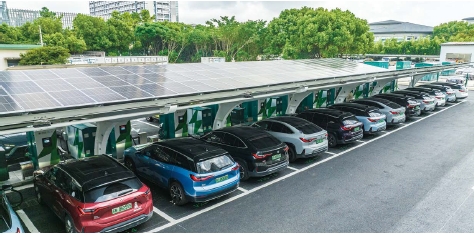
More importantly, as China鈥檚 largest 鈥淧V generation, charging, storage, discharging, inspection, and swapping鈥?demonstration project, the Wuxi Vehicle-to-Grid Interaction Center has fully leveraged the mobile storage function of NEVs. Through coordinated interactions across source, grid, load, and storage, the Center enables seamless energy and load integration and flexible transformation, addressing the power access demands. The Center has resolved the conflict between the growing adoption of NEVs and the relatively poor charging and swapping infrastructure, while also alleviating the pressure that EV growth poses on stable grid operations.
With favorable winds, one should set sail. With heavy responsibilities, one must forge ahead. The V2G era has begun in China, yet the road ahead remains long and challenging. In the face of a strategic push to construct a new electric power system dominated by a high share of renewable energy, State Grid Wuxi as a pioneer and pathfinder will continue its forward march. By harnessing resources across policy, industry, technology, innovation, and function, it aims to build China鈥檚 leading vehicle-grid interaction demonstration project. To this end, the company will follow the major path of vehicle-grid interaction, validate two pathways of intelligent and orderly charging and discharging, and vigorously construct the three engines 鈥?scenario platforms, technical strategies, and policy markets. Therefore, the company can contribute Chinese solutions and 鈥淲uxi wisdom鈥?to advance global energy transition and green development.
 Back
to top
Back
to top