
Ushering in a zero-plastic era for Lenovo laptops
Abstract: To address the dependence on virgin plastics in electronic products, Lenovo, through research and development, achieved a milestone in 2021 by becoming the first company to mass-produce “zero plastic” adapters. These adapters use recycled plastic, constituting 95% of their material, eliminating the need for virgin plastics. The initiative has been applied to other components like laptop batteries, speakers, and internal parts. In the 2022 fiscal year, Lenovo utilized approximately 1,710 tons of “zero plastic,” resulting in a reduction of around 4,400 tons of carbon dioxide emissions. Concurrently, acting as a leader in the supply chain, Lenovo has been instrumental in encouraging stakeholders to reduce their plastic usage.
Challenge
Plastic pollution is a global crisis demanding urgent action. Since the 1950s, over 80 billion tons of plastic have been produced, with primary plastic production projected to reach 34 billion tons by 2050. An estimated one million seabirds and 100,000 marine animals die annually from plastic ingestion, and over 90% of birds and fish now carry microplastic particles in their stomachs. The average person consumes over 70,000 microplastic particles each year.
In the laptop industry, a single ThinkPad uses plastic extensively — in its casing, keyboard, battery, charger, and internal components — consuming roughly 8,000 tons of virgin plastic annually. Derived from petroleum refining, this virgin material not only depletes fossil resources but generates substantial carbon emissions. Increasing the use of recycled plastics, and ultimately eliminating virgin plastic entirely, has been a long-standing focus for Lenovo.
Solution
Lenovo began developing zero-plastic products in 2019, starting with 45W and 65W power adapters. The core challenge was flame retardants: conventional phosphorus-based additives require at least 15% content to achieve V0 flame rating, while a Sony proprietary retardant needed only 0.3%, opening the door for dramatically higher recycled content.
After 500 formulation trials and nearly 40 rounds of validation, the 45W adapter passed all tests. For the 65W adapter, the team resolved structural strength issues by switching to hot-runner injection molding, repositioning gates, and adding rib thickness and curvature. Mass production began in early 2021 following pandemic-related disruptions. Both adapters achieved 95% recycled content, with the remaining 5% being additives only — a true zero-virgin-plastic breakthrough.
The R&D team then extended this approach to laptop batteries, speakers, and internal structural parts. Battery plastic frames required thinner, more flexible material; drawing on adapter experience across formulation, molding, and structural design, the team completed material development in under a year, reaching 97% recycled content — again entirely free of virgin plastic.
Lenovo also established aging test protocols for plastic and battery products, ensuring decade-plus reliability, and it co-created process design guidelines with ODM partners. On the supply side, Lenovo worked with Sony to relocate water-barrel recycling from the Middle East to China, achieving 100% domestic recovery — over 1,000 tons annually — better protecting China's environment.
Impact & Value
The zero-plastic adapters and batteries achieve 95% and 97% recycled content respectively, entirely free of virgin plastic — 95% PCR content reduces CO2 emissions by approximately 72% compared to virgin materials. By FY2022, Lenovo had used approximately 1,710 tons of zero-plastic materials, cutting roughly 4,400 tons of CO2 emissions, equivalent to the ten-year carbon absorption of 72,000 trees.
Socially, Lenovo's aging test protocols and process design guidelines provide an industry reference standard, accelerating adoption toward 90% recycled plastic across the sector.
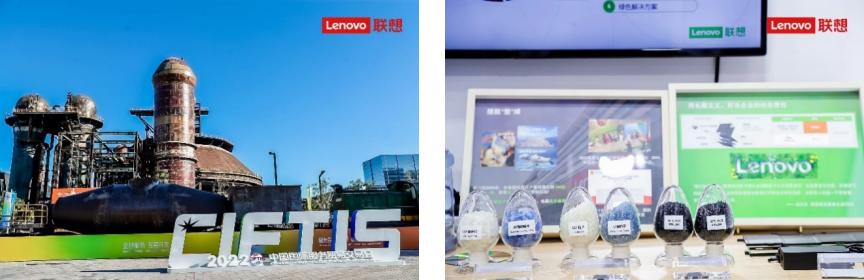
The zero-plastic products earned Lenovo's internal Wanfeng Award in FY22/23 and were showcased at CIFTIS 2022 and other national exhibitions. The initiative has been widely shared at the 2023 Industrial Green Development Conference, Intel China Sustainability Summit, and the 26th China Plastics Recycling Conference.
Lenovo aims to leverage its experience to collaborate with industry peers in building a greener, plastic-free and waste-free future, with further exploration of a fully zero-plastic laptop on the horizon.